On the night before the election, Keisha Lance Bottoms did not hold a rally. She drove to Crawfordville, a small town in east Georgia, to stand at the graves of her ancestors. Her family's roots there go back at least five generations, to a plantation where they were enslaved. Generations later, some of them left for Atlanta by horse and buggy, looking for something better. The Atlanta Journal-Constitution reported that she told supporters it was a trip she needed to make before the campaign ended.
Twenty-four hours later, Georgia elected one of their descendants governor.
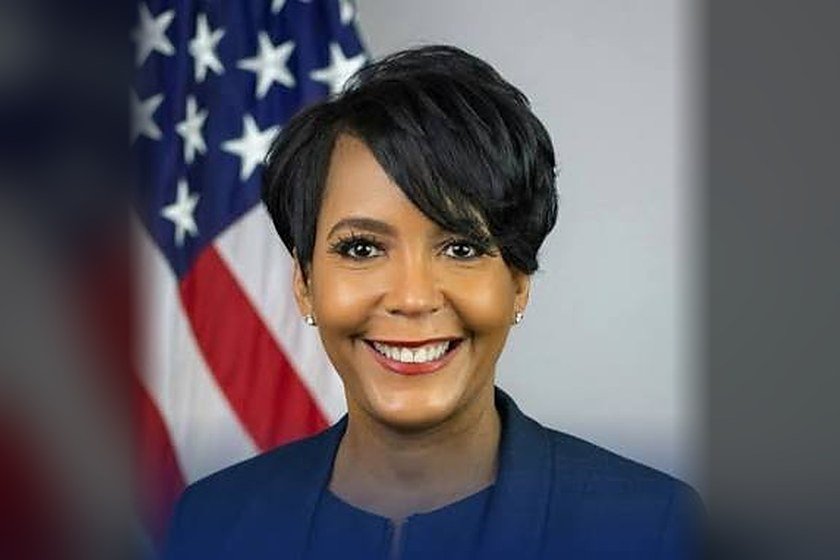
The Associated Press called the race late Tuesday night. Bottoms, the Democrat and former mayor of Atlanta, defeated Republican businessman Rick Jackson to become the first Black woman ever elected governor of any state in the country. She is also Georgia's first woman governor and its first Black governor, and the first Democrat to win the office since 1998, according to AP's report. She will succeed Gov. Brian Kemp, who was barred by state law from seeking a third consecutive term, CBS News noted.
Read those firsts slowly. A state that sat at the center of the Confederacy, the civil rights movement and the New South has now handed its highest office to the great-great-granddaughter of people it once held in bondage. That is not a footnote. That is a chapter.
A very short list
To understand the size of this moment, look at how few names come before it. Women have been governing American states since Nellie Tayloe Ross took office in Wyoming in 1925. In the century since, not one of them was a Black woman. Until Tuesday.
Black men have not fared much better. Bottoms becomes only the fourth Black governor ever elected in the United States. The three before her were Douglas Wilder of Virginia, elected in 1989, Deval Patrick of Massachusetts in 2006, and Wes Moore of Maryland in 2022. A handful of others served without winning a governor's race, most famously P.B.S. Pinchback, who held Louisiana's office for a few weeks during Reconstruction, and David Paterson, who rose from lieutenant governor in New York in 2008.
Georgia itself had come close and fallen short. Stacey Abrams built a national profile and an organizing machine across two campaigns, and lost both to Kemp, in 2018 and 2022. Many of the voters she registered and the infrastructure she helped build were still in place this year. History rarely credits the people who clear the ground. It should.
Bottoms was not the only Black woman on a governor's ballot this cycle. AP pointed out that eight Black major party nominees ran for governor on Tuesday, among them Republican Lisa Demuth in Minnesota. That number alone tells you something about where Black political ambition stands in 2026: no longer a novelty, increasingly a pipeline.
Collier Heights, then everything after
Her story starts in comfort and then falls hard. Bottoms grew up in Atlanta as the daughter of soul singer Major Lance, a hitmaker who once opened for the Beatles. The family lived in Collier Heights, the west Atlanta neighborhood where Black builders and buyers created their own upscale enclave in the years after World War II, a place that has long stood as proof of what Black homeownership could look like when it was allowed to flourish.
Then the music faded, and addiction took over. When she was 8, she came home from school to see police leading her father away in handcuffs on cocaine distribution charges, the AJC recounted. He went to prison. The family lost the house. Her mother, Sylvia Robinson, cycled through low-paying jobs before opening a beauty salon in the West End. Weekends meant prison visits. Bottoms has said that season of her life is where her belief in second chances comes from.
Readers of this magazine will recognize the shape of that story, because so many of our families carry a version of it. A home won, then lost. A mother who kept the lights on by turning a trade into a storefront. A child who learned early that stability is not a given and that someone has to build it back. The salon in the West End is as much a part of this victory as any campaign office.
From there the résumé reads like a deliberate climb. Florida A&M University. A law degree from Georgia State. Work as a prosecutor and then a judge. A seat on the Atlanta City Council in 2009. And in 2017, a long-shot run for mayor that ended in a runoff she won by just 823 votes over Mary Norwood after a recount fight.
A record that never stopped following her
Any honest account of this win has to deal with the mayoralty, because Georgia voters certainly did.
Her four years at City Hall were defined by crisis. A ransomware attack crippled city government. Then came the pandemic, during which she clashed openly with Kemp over restrictions. Then the summer of 2020. After George Floyd's murder, her plea to people damaging downtown Atlanta to go home made her a national figure and briefly put her on the shortlist to be Joe Biden's running mate.
That same summer brought the moments her critics never let go. Atlanta police killed Rayshard Brooks outside a Wendy's in June. The restaurant was burned, and the area around it slid into disorder. On July 4, 8-year-old Secoriea Turner was shot and killed in a car near the site. Questions about whether the city moved quickly enough to restore order have followed Bottoms ever since, and she told the AJC she has often asked herself the same thing. Violent crime rose. A movement to split Buckhead off from the city gained steam. Critics called her an absentee mayor.
Bottoms pointed to raises for police and firefighters, balanced budgets and pandemic relief for residents and small businesses. Then, in 2021, she surprised the city by declining to seek a second term, and later joined the Biden White House as a senior adviser.
Jackson, a 72-year-old healthcare executive who rose from foster care to become a billionaire, built his campaign around that record. He spent more than $200 million of his own fortune, according to the AJC, repeating a simple line: bad mayors don't make good governors. Bottoms answered by turning the race toward the future, with promises to expand Medicaid, guarantee access to Georgia's pre-K program, let local governments reduce taxes on groceries and pause new data center construction, and by tying Jackson closely to President Trump.
Georgians weighed both arguments. On Tuesday, more of them chose hers, and by the time AP made its call, the margin was not close enough to leave the outcome in doubt.
What it means beyond the ballot
There is a temptation, on nights like this, to make one person carry the weight of an entire people's hopes. Bottoms herself resisted it. She rarely spoke openly about the historic nature of her run, preferring to talk about health care, wages and costs at the kitchen table.
But representation is not only symbolic, and it is not only political. It changes what children assume is possible. Somewhere in Georgia tonight is a little girl whose mother does hair in a strip-mall salon, whose father is away, whose family just lost a house. She has never had a reason to picture herself in the governor's mansion. Now she has one, and it looks a lot like her.
It also says something about the economics of Black Georgia. AP framed the win as part of a larger story: the growth of metro Atlanta is reshaping the state's politics, overriding a long reluctance to put an Atlantan in the top job. That growth is Black professionals relocating from the North and Midwest, Black entrepreneurs scaling in the suburbs, Black families buying homes in counties that used to be out of reach. Ownership and influence travel together. They always have.
And for those of us who believe that a family's story is longer than any one life, the arc here is hard to miss. Enslaved in Crawfordville. Free and moving to Atlanta by buggy. A home built in a proud Black neighborhood. That home lost. Then, generations after the journey began, a daughter of that line taking an oath to lead the whole state. Legacy is rarely a straight line. It is usually a long obedience in the same direction, and plenty of the people who walked it never saw the end of the road.
The hard part starts now
Bottoms takes office in January facing a Republican-controlled legislature, and her most ambitious promises will run straight into it. Before she is even sworn in, Kemp and Republican lawmakers have been debating a possible special session that could redraw political boundaries and limit some of the governor's powers, a move she has warned would damage Georgia's reputation.
Her first year will be judged on results, not on history. That is as it should be. The first Black woman to govern an American state deserves exactly what every governor deserves: a fair hearing, honest scrutiny and the chance to show what she can build.
Tonight, though, belongs to the history. To the graves in Crawfordville. To the salon in the West End. To every Black woman who ran, organized, knocked doors or simply voted in a state that once told her she could not. The list of Black women who have governed an American state is no longer empty. It has a name on it, and the name is from Georgia.