On September 24, 1987, NBC introduced America to a fictional Virginia college called Hillman. On September 24, 2026, exactly 39 years later, Netflix brought it back, dropping all ten episodes of a new A Different World at once.
The date was a deliberate choice, and it tells you how seriously the people behind this sequel take what they inherited. For a lot of Black families, Hillman was never really fictional. It was the first college campus many of us ever saw on television where everyone looked like us, and where being brilliant, stylish, political, and Black was the default setting rather than the plot twist.
The question hanging over the new version is whether it can matter the way the old one did. The honest answer is: not in the same way, and maybe not yet. But it matters, and it is worth your time.
The campus that sent a generation to campus
The original A Different World ran from 1987 to 1993, and its reputation as a recruiting tool for historically Black colleges is almost as famous as the show itself. The numbers behind that reputation are real. According to reporting by the Atlanta Journal-Constitution's UATL, HBCU enrollment rose from about 223,000 students in 1986 to more than 280,000 by 1994, an increase of roughly 26 percent.
That is worth saying precisely, because the story often gets inflated. Debbie Allen, the show's creative force, has said it tripled HBCU enrollment. The federal data does not support tripling. It also does not need to. A one-quarter jump in six years is an extraordinary shift, and the people who lived it do not need a statistic to confirm it. Darryl M. Bell, who played Ron Johnson, has said that fans regularly tell him they chose an HBCU because of the show.
It is also fair to note that the show did not act alone. TheGrio points out that Black college enrollment overall grew by nearly 40 percent over the same stretch. Spike Lee's School Daze landed in 1988. Doors were opening across American higher education. What A Different World did was put a face, a dorm room, and a cafeteria on the idea of a Black college, and make millions of teenagers want to walk into one.
Look at who lived at Hillman. Dwayne Wayne, the math whiz from Brooklyn with the flip-up glasses. Whitley Gilbert, the Richmond belle who treated a dorm like a debutante ball. Freddie Brooks, the activist. Kim Reese, the pre-med student paying her way by working at the campus diner. Ron, the hustler with a good heart. These were not role models in the flat, after-school-special sense. They were funny, vain, stubborn, and wrong about things. That is why they worked. Black excellence on that campus came with Black personality attached.
Laughing all the way to the hard part
After a rocky first season, Debbie Allen took the show over and turned it into something bolder. Netflix notes that she produced 122 episodes of the original and directed 83 of them. Under her, A Different World developed a signature move: make the audience laugh, and then, once their guard is down, tell them the truth.
In "No Means No," a second-season episode Allen directed, Dwayne worries that Freddie is dating a predatory athlete. The episode became a primer on consent at a time when network sitcoms rarely said the phrase "date rape" out loud.
In "If I Should Die Before I Wake," Tisha Campbell played Josie, a student who reveals she is HIV positive during a class assignment to write her own obituary. Whoopi Goldberg played the professor. As The Root has written, the episode showed classmates recoiling from Josie at the campus diner, and then showed a better way through the man who ran that diner, Mr. Gaines, who met her with compassion instead of fear. Choosing a young Black woman to carry that story, in that era, was a statement.
And in the sixth-season premiere, "Honeymoon in L.A.," newlyweds Dwayne and Whitley arrive in Los Angeles just as the 1992 unrest breaks out after the Rodney King verdict. Dwayne, furious, kicks the tires of his rental car and nearly gets arrested for it. Jasmine Guy later reflected that the cast did not change the world with that episode, but they refused to pretend it was not happening to them.
That was the genius of the original. Comedy was not a way of avoiding serious subjects. It was the delivery system.
The man behind the counter
No tribute to Hillman is complete without Mr. Vernon Gaines, the gruff owner of The Pit, the campus hangout where half the show's best scenes happened. He was grumpy, a veteran, allergic to nonsense, and quietly the most dependable adult on campus.
He was played by Lou Myers, and the man behind the character had more Hillman in him than most viewers knew. Myers served in the Air Force in the early 1950s, then earned his bachelor's degree at West Virginia State University, itself a historically Black institution, before completing a master's in theater at NYU. He appeared in 88 episodes of the original and died in February 2013 at 77.
The sequel honors him in a way that feels right. The Pit is still standing, and it is now run by Nellie Gaines, Vernon's granddaughter, played by Famecia Ward. And when the returning cast first walked onto the new set, Bell told Andscape, there was a picture of Lou on the wall. Legacy, in other words, is not just a theme of this show. It is literally hanging on the wall of its most important room.
Who is at Hillman now
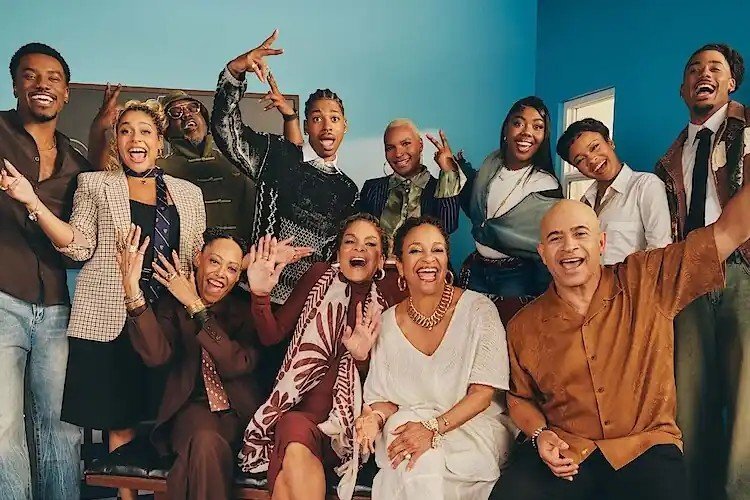
The new series, run by Felicia Pride (Bel-Air, Grey's Anatomy), centers on Deborah Wayne, played by Maleah Joi Moon. She is the youngest child of Dwayne and Whitley, and she arrives at Hillman to find that her father is now the provost and her mother, a beauty mogul, has a dorm named after her. Escaping your parents' shadow is hard enough. Escaping it when they run the campus is its own sitcom premise.
Her classmates are played by Alijah Kai, Chibuikem Uche, Cornell Young IV, Jordan Aaron Hall, and Kennedi Reece, who, like Debbie Allen, is a Howard University graduate. Brandy sings the updated theme.
The returning cast is the sequel's secret weapon. Kadeem Hardison and Jasmine Guy are back as Dwayne and Whitley, now three decades into a marriage that the Hollywood Reporter notes is on the brink of divorce. Cree Summer's Freddie is now a Hillman professor, and Bell's Ron manages his famous football-player son. Charnele Brown, Dawnn Lewis, Glynn Turman, Jada Pinkett Smith, Karen Malina White, Ajai Sanders, and Jenifer Lewis all return as well.
The sequel also keeps the original's instinct for the headlines. A funding crisis driven by shrinking federal support hangs over campus, and the show treats the business of running a Black college as a real story rather than background noise.
The caveats
Here is where honesty matters. The new A Different World is good, but it is not the original, and critics have been clear about why.
The reviews are generally warm. The series sits at 79 percent on Rotten Tomatoes and 72 on Metacritic. Time found it has less spark and wit than the classic but plenty of heart, and noted that it plays more like modern teen dramas such as Bel-Air than a traditional sitcom. TVLine was tougher, calling it too light on the charisma that made the original special and saying some of the returning cameos drift into fan service. The Hollywood Reporter described it as fun, thoughtful and messy, and argued that it really takes off once it steps out from under its parent's shadow.
The biggest difference is structural. There is no laugh track, and the show leans harder into drama. That is a defensible choice for a streaming series in 2026, but it gives up the very thing that made the original so effective. The old Hillman made you laugh your way into a conversation about AIDS. The new Hillman is more likely to just have the conversation. It is sincere, and sincerity is admirable, but the jokes were how the medicine went down.
Why it is still worth your Thursday night
Even with those caveats, this sequel deserves an audience, and it arrives at a meaningful moment. HBCUs are growing again. According to Inside Higher Ed data cited by MS NOW, 42 of 101 HBCUs grew their enrollment between 2019 and 2024, and Howard grew by half in those five years. A new generation is choosing Black colleges for reasons that sound a lot like the ones that moved their parents: belonging, excellence, and the chance to come of age somewhere they are not explaining themselves.
Television that shows Black young people as ambitious, funny, complicated, and worth investing in is not a small thing. It never was. And a show that brings back a cast of Black actors now in their fifties and sixties, and treats them as the institution builders they became, says something the original could only hint at: that the students grow up, and the campus is still there because they kept it standing.
So which A Different World is better? The original, and it is not close. It was sharper, funnier, and braver in its time. But the question misses the point. The original built Hillman. The sequel proves it is still open.
Watch it. If there is a teenager in your house weighing colleges, watch it with them. And the next time you see a picture of Mr. Gaines, pour one out for the man behind the counter.