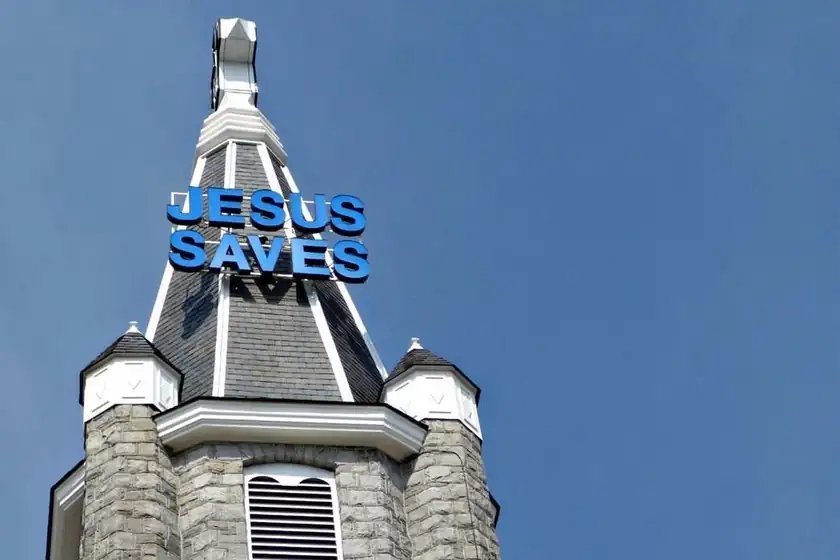
In Atlanta, there is a sign that locals treat as part of the skyline. On top of a stone church steeple on Auburn Avenue, a lighted cross carries two words stacked one above the other: Jesus Saves. After dark it glows over the east side of downtown. Generations of Atlantans have given directions by it, photographed it, and driven right past it without ever asking what it sits on.
Auburn Avenue deserves an introduction of its own. After the Civil War, as segregation shut Black Atlantans out of the white business district, this street became the center of Black commercial and civic life in the city: banks, insurance companies, newspapers, churches, and the homes of the families who ran them. It came to be known as Sweet Auburn. Martin Luther King Jr. was born a few blocks down the same street. Today the neighborhood is a National Historic Landmark district.
The church under the sign is Big Bethel African Methodist Episcopal Church, and it is the oldest African American congregation in Atlanta. It is older than the Civil War. It is older than every historically Black college in the city. It gave birth to one of them, housed a public school for Black children in its basement, and wrote a play in 1930 that kept the doors open through the Great Depression. That play still runs.
The sign is not decoration. It is a receipt.
Before there was a building
In 1847, Atlanta was a young railroad town with one shared house of worship, a congregation called Union Church. Enslaved men and women were permitted to worship there alongside the people who held them in bondage, on terms those people set. According to the Atlanta History Center, that arrangement did not last: the enslaved worshipers were eventually barred from worshiping with white parishioners, and they formed a congregation of their own.
Think about what that meant in practice. These were people who could not legally own property, sign a contract, or move freely. They organized anyway. The church's own history records that they petitioned for a building of their own, that $700 was set aside for it, and that in 1855 they moved into a structure they named Bethel Tabernacle. Bethel is Hebrew for "house of God." It was the first thing in Atlanta that was, in any meaningful sense, theirs.
A church the war took, and a debt nobody paid
The Civil War came for the building. During the fighting it was pressed into service as a hospital, and when Union troops occupied Atlanta, it was destroyed. What happened next is one of the most quietly radical documents in the church's story. According to Clio's history of the site, which draws on National Archives records, members of the congregation wrote to the federal government after the war asking for $7,000 to rebuild, framed as reparations for what had been taken.
No money was ever paid.
They rebuilt anyway. In 1866, as soon as freedom made it possible, the congregation joined the African Methodist Episcopal Church, the denomination founded by Black Methodists who had walked out of a segregated Philadelphia church decades earlier. A new brick sanctuary went up on Auburn Avenue in 1868. The members who had once needed permission to pray now answered to a Black denomination, in a Black-owned building, on a street that would become the heart of Black Atlanta's business and civic life.
The classroom in the basement
A church in the Reconstruction South was never just a church. It was a meeting hall, an employment office, a relief society, and a school, because there was nowhere else for those things to happen.
In 1879, the basement of Big Bethel became home to the Gate City Colored School, which BlackPast identifies as the first public school for African Americans in Atlanta. The women of the congregation, meanwhile, organized the Daughters of Bethel Benevolent Society, a mutual aid group that W.E.B. Du Bois later pointed to as an early model of Black self-help.
Then came the college. The way the story is told at Morris Brown College, trustees from nearby Clark College visited Big Bethel asking members to help furnish a room at their school. A layman named Steward Wiley pushed back with a question that deserves to be carved over a doorway somewhere: if they could furnish a room at Clark, why couldn't they build a school of their own?
The Reverend Wesley John Gaines took that question and ran with it. In January 1881, at the North Georgia Annual Conference of the AME Church, held at Big Bethel, he introduced the resolution that created Morris Brown College. Trustees met at the church to choose a site at Boulevard and Houston Street. When the college opened its doors in October 1885, 107 students and nine teachers walked in, at the first institution of higher learning in Georgia founded by and for African Americans.
That is the sequence worth sitting with. Not "someone gave us a school." Instead: someone asked for our money to support their school, and we decided to build our own.
The fire, the lapsed policy, and the sign
By the late 1880s, the congregation had outgrown its brick church and built a grand Victorian sanctuary next door. That is the building that gave "Big" Bethel its name.
In 1923 it burned. The New Georgia Encyclopedia notes a detail that every reader of this magazine should feel in their chest: the church's building insurance had expired the day before the fire. Not the month before. The day before.
The congregation was left with old building debts and no sanctuary, and it rebuilt the way it always had, with its own people. The new church was designed in the Romanesque Revival style by African American architect John Anderson Lankford and raised by African American builder Alexander Hamilton. And it was during that reconstruction that the cross reading "Jesus Saves" was installed on the steeple.
So the sign that half the city treats as a landmark was born out of a disaster. It went up over a church that had just lost everything, on a building financed by a congregation that was still paying off the last one. Whatever else it says, it says: we are still here.
Ten cents a seat
Rebuilding cost money the church did not have, and the Great Depression was arriving right behind the bills.
Two women in the congregation, Lula Byrd Jones and Nellie Davis, were Sunday school teachers and choir members. They were not playwrights by trade. They wrote a play anyway. Heaven Bound follows a line of pilgrims trying to make it to the gates of heaven while Satan works every angle to pull them off the road. Some make it. Some do not. The story is carried by spirituals.
It opened at Big Bethel on February 17, 1930. The Atlanta Journal-Constitution reports that admission was ten cents.
It was a fundraiser, and it worked far beyond what anyone planned. The Theatre Guild soon called it "the first great American folk drama." White audiences across the country encountered Black theater through it. Because Black performers were shut out of mainstream stages in the South, the production kept its home inside the sanctuary, and the church's arches and chancel became the set. Heaven, in Heaven Bound, looks like Big Bethel.
The Georgia Historical Society's marker credits the play with sustaining the church through the Depression. Two volunteers with a script did what a lapsed insurance policy could not.
The play has been staged year after year since 1930, pausing only when the pandemic forced a two-year break, and returning in 2022 for its 90th run. The church describes it as the longest-running musical in North America. Some of today's cast have played the same role for decades. One longtime actor told GPB that she has played a pilgrim who does not make it to heaven for more than seventeen years, and that the role makes her examine her own life. That is a ministry disguised as a production.
City hall for Sweet Auburn
Through the twentieth century, Big Bethel functioned as a civic anchor for the Sweet Auburn district. It hosted political gatherings and rallies. During the civil rights era, its services went out over the radio. The pulpit and pews have hosted national figures from President William Howard Taft to Nelson Mandela, and the building sits inside the Sweet Auburn Historic District, a National Historic Landmark.
In later decades the church's work turned toward housing and toward people who are easy for a city to forget, including the poor and the incarcerated. The through-line never changed. Whatever the community needed that the city would not provide, the church tried to build.
What the sign is actually saying
It would be easy to read all of this as a faith story and leave it there. It is a faith story. But it is also one of the clearest ownership stories in Atlanta, and it is worth reading that way.
Look at the pattern. People with no legal rights organized an institution. When the government destroyed their building, they documented the loss and demanded restitution, and when restitution never came, they rebuilt without it. When another institution asked for their money, they chose to build their own. When a fire caught them uninsured, they hired their own architect, used their own builder, and let two Sunday school teachers write their way out of debt.
None of that required wealth. It required ownership thinking: the conviction that what we build, we keep, and what we keep, we protect. The lapsed insurance policy is the part of the story that should stay with anyone building something today. The generation that survived slavery and war nearly lost everything to a single missed renewal. Stewardship is not only faith and vision. It is also paperwork.
"Except the Lord build the house, they labour in vain that build it," Psalm 127 says. Big Bethel has spent nearly two centuries living both halves of that verse: trusting God with the house, and still showing up to lay the stone.
So if you are ever in Atlanta after dark and that cross catches your eye, do not drive past it. You are looking at a school, a college, a mutual aid society, a stage, a civil rights hall, and a congregation older than the city's own sense of itself. You are looking at what Black Atlanta built when it was told it could own nothing.
And if your travels bring you to Atlanta in the fall, when the church traditionally stages Heaven Bound, go see it. Check bigbethelame.org for dates. It costs more than ten cents now. It is still worth it.